
The Revolution in Industrial Drying: Understanding the Inorganic Dedicated Flash Dryer Production Line
In modern industrial processing, efficiency and precision are paramount. For industries dealing with wet powders, filter cakes, and granular materials, the drying stage is often a critical bottleneck. The solution to this challenge is increasingly found in advanced thermal processing technologies, chief among them being the Inorganic Dedicated Flash Dryer Production Line. This sophisticated system offers a method for rapidly and uniformly drying materials that might otherwise be sensitive to prolonged heat exposure or difficult to handle. By utilizing a high-velocity, heated gas stream, flash dryers can evaporate moisture in a matter of seconds, transforming a complex process into a streamlined, continuous operation that preserves product quality and maximizes output.
The Core Principle of Flash Drying Technology
At its heart, flash drying is a convective drying method. The fundamental process involves dispersing the wet material into a stream of hot air or gas, which then conveys it through a drying duct. The intense turbulence and contact between the hot gas and the fine particles result in an extremely high rate of heat and mass transfer. This allows for near-instantaneous evaporation of surface moisture. A key characteristic of this technology is the very short residence time of the material within the dryer, typically lasting only a few seconds. This rapid process is particularly advantageous for materials that are heat-sensitive, as it minimizes the risk of thermal degradation. After passing through the drying duct, the dried product is separated from the gas stream, usually by a cyclone separator and often followed by a bag filter or wet scrubber to capture any remaining fine particles, ensuring high product yield and minimal environmental impact.
Tailored for the Demands of Inorganic Materials
Why is a system often described as an Inorganic Dedicated Flash Dryer Production Line? Inorganic materials—such as minerals, catalysts, pigments, and certain chemical salts—present unique challenges. They can be abrasive, corrosive, or require very high processing temperatures. A dedicated system is engineered specifically to handle these properties. The construction often involves robust, abrasion-resistant materials like specialized stainless steel or alloys to withstand the wear and tear from hard particles. The design also accounts for the specific thermal properties of these materials, ensuring that the heat input is precisely controlled to achieve the desired final moisture content without causing chemical changes or particle fusion. Furthermore, the system is designed as an integrated production line, encompassing everything from the wet material feeding mechanism to the final product collection and gas exhaust treatment, ensuring seamless and efficient operation from start to finish.
A Closer Look at a Modern Flash Dryer System
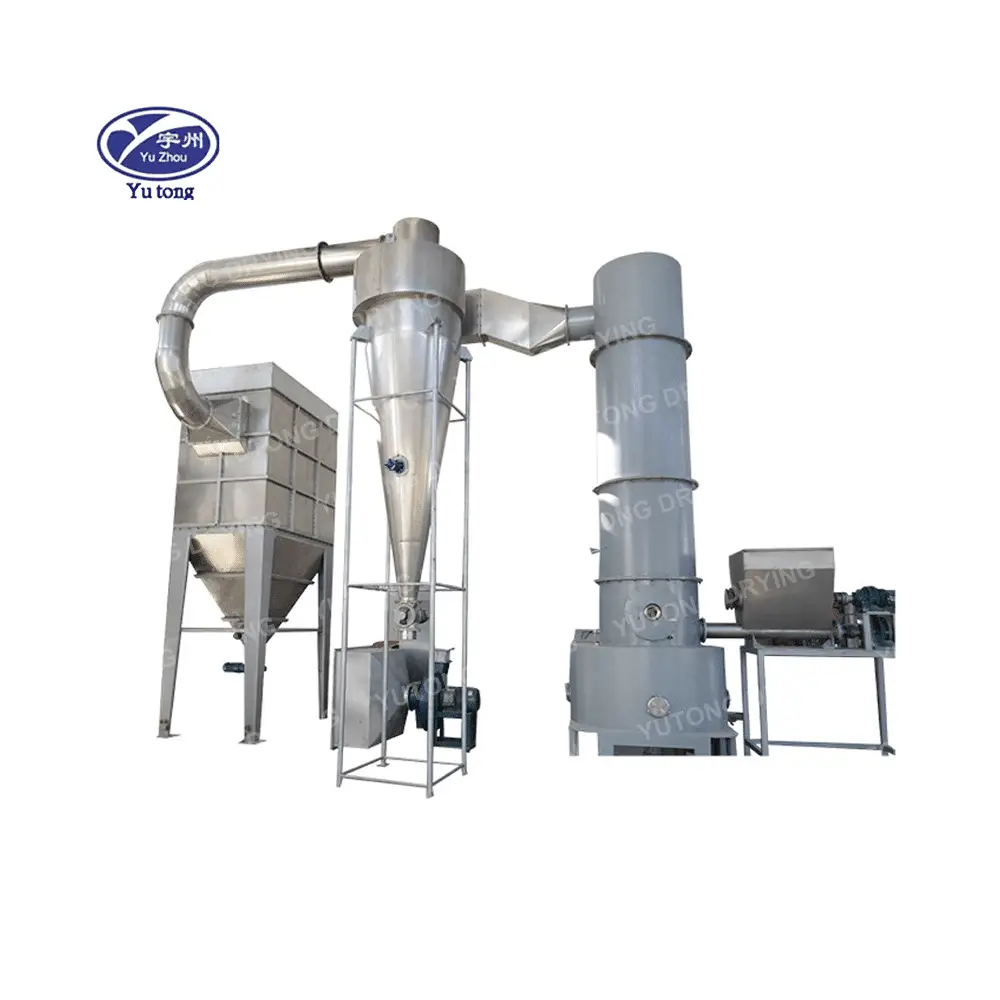
A prime example of cutting-edge technology in this field is the industrial flash dryer, which embodies efficiency and innovation. Such a system is a marvel of industrial engineering, designed to revolutionize material processing. A typical unit is equipped with advanced drying mechanisms capable of handling a diverse range of inorganic materials. Its towering, streamlined formation is not just for aesthetics; it is crucial for ensuring maximum airflow and optimal heat distribution, which facilitates the rapid moisture evaporation essential for the process. An integral part of the system is the cyclone separator, which enhances productivity by efficiently segregating the dried product from the airstream. The use of high-grade stainless steel in its construction promises durability and resilience, making it suitable for even the most demanding industrial environments. Modern designs also emphasize ease of maintenance and operational reliability, featuring intuitive access points and secure fittings to guarantee peak performance.
Applications and Unmatched Benefits
The applications for an Inorganic Dedicated Flash Dryer Production Line are vast and varied. It is an indispensable tool in the chemical industry for producing pigments, catalysts, and various salts. In the minerals sector, it is used for drying clays, kaolin, and calcium carbonate. The technology also finds a place in the manufacturing of ceramics and other advanced materials. The benefits are clear and compelling. First and foremost is the incredible efficiency; the rapid drying process dramatically reduces processing time compared to batch dryers. This leads to significantly higher throughput. Second, the short residence time and controlled temperature profile ensure a high-quality, uniform final product with consistent moisture content. Third, flash dryers typically have a smaller footprint compared to other continuous dryers of similar capacity, saving valuable plant space. Finally, these systems are designed for continuous, automated operation, reducing labor costs and improving overall process control and safety.